A new drug offers hope for children with rare Hunter syndrome
FDA grants accelerated approval for treatment targeting both body and brain
CHAPEL HILL, N.C. (InvestigateTV) — Nearly 10% of Americans live with a rare disease, and most of these conditions have no approved treatment options.
One of those conditions, Hunter syndrome, mostly affects boys and has had only one approved treatment since 2006. A new drug approved this year is offering families a different outlook.
Rare diseases are referred to by patients and doctors as “orphan diseases” because they receive little attention in research and health care, according to the National Institute for Children’s Health Quality.
Most rare diseases, about 72%, are genetic, and of those, about 70% start in childhood. Children living with rare disorders often face long delays for an accurate diagnosis, a process often called “a diagnostic odyssey,” along with chronic physical and mental health issues and complex care needs.
Hunter syndrome, also known as mucopolysaccharidosis type two, or MPS II, is one such genetic disease. Since 2006, enzyme replacement therapy has been the only approved treatment, but that medication addressed only some physical symptoms of the disease, such as joint stiffness.
Diagnosis after months of questions
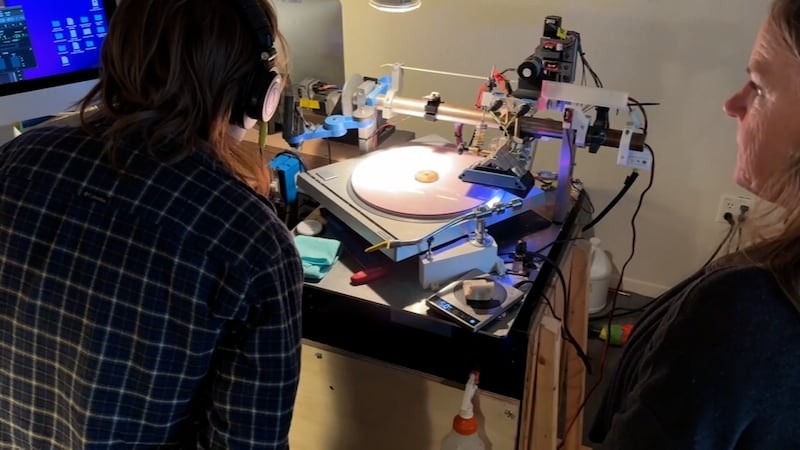
Atlas Neuerburg is almost 4 years old. He likes to spin vinyl records on his father’s turntable, is a fan of John Candy, Michael J. Fox and “Back to the Future,” and practices swinging a bat in his yard.
Before Atlas’ parents, Nick and Jenny Neuerburg, had a name for their son’s condition, they were in and out of doctors’ offices for what seemed like typical early childhood issues.
“He was just a little bit slow with gross motor stuff. He was slow to crawl. Slow to walk,” Jenny Neuerburg said.
During Atlas’ regular 18-month checkup, a doctor examined his stomach.
“The doctor touched his stomach and asked if it always felt hard like that,” Jenny Neuerburg said. “Then she called us the next morning and said, ‘I’ve been thinking of his stomach all night and it’s bothering me.’”
A hard or distended stomach is a common sign of MPS II, according to the Cleveland Clinic. Other early indicators include a wider than normal head, chest and short neck; stiffness in the joints; persistent ear infections or hearing loss; and distinctive facial features.
Symptoms generally appear between 18 months and 4 years of age, and the most severe cases can be life-threatening.
“That led to blood tests and eventually genetic testing and that’s how we found out,” Jenny Neuerburg said. “The day after Christmas, so we’ll always remember that.”
Relocating for clinical trial
At the time, the Neuerburgs lived in Kansas. A specialist at Children’s Mercy Hospital in Kansas City pointed them toward North Carolina.
“We actually packed up our entire house in Kansas City and started driving across country,” Nick Neuerburg said.
The couple’s research led them to Dr. Joseph Muenzer, a pediatric geneticist with UNC Health in Chapel Hill and an expert in Hunter syndrome and other forms of MPS. His clinic is one of a handful of sites in the country running a clinical trial for a drug that targets neurological aspects of the disease.
“There’s probably four or five sites around the country,” Muenzer said.
Children with Hunter syndrome are unable to produce the enzyme that typically clears a buildup of cellular waste material, known medically as glycosaminoglycans, or GAGs. Without the enzyme, the material builds up and leads to progressive damage in the body and brain.
The trial Atlas joined tested a weekly intravenous infusion that replaces the missing enzyme. Unlike other treatments, it crosses the blood-brain barrier — the tightly locked layer of cells that defend the brain from harmful substances — allowing it to reach both body and brain.
“I preach both the physical disease and the brain disease, something we didn’t have before. So it’s a life changer for the MPS II community,” Muenzer said. “For the first time, for a lot of these families, they were given hope.”
Atlas joined the trial as a toddler, celebrating his third birthday during one of his weekly infusions.
More than two years later, he shows no further signs of decline. Muenzer said other trial participants are seeing similar results.
“I have a few patients in the clinical trial who were started when they were around two years of age,” Muenzer said. “And now at six and seven, you almost don’t know they have Hunter’s syndrome anymore because their physical disease basically has not developed, and they’re developmentally appeared to be normal.”
A mother’s hope
In March 2026, the Food and Drug Administration granted accelerated approval for the drug, called Avlayah, for patients through age 16.
Kim Stephens, executive director of the Muenzer MPS Research and Treatment Center, believes the approval is what patients’ families have been waiting for.
“We’re going to have some kids that won’t develop like a typical Hunter syndrome child. And that’s going to be really amazing for our community,” Stephens said.
Stephens’ son, Cole, was diagnosed with Hunter syndrome at age 2. As the disorder progressed, Cole lost most language skills except for two words: “help” and “mommy.”
Today, Cole is 15, and it’s unlikely he’ll say the word “mommy” again.
Stephens knows Avlayah is not a cure and won’t reverse what Cole has lost. But she hopes the drug can slow what comes next.
“[I] want him to be able to laugh and run and enjoy his favorite things and do puzzles and just continue to be the happy child he is,” Stephens said.
In May 2026, Cole received his first infusion. After the initial doses, Stephens said she sees a difference in Cole’s ability to focus. While she can’t say for sure whether the change is the direct result of the drug, she feels strongly it is.
Cost and access
A spokesperson for Denali Therapeutics, the manufacturer of Avlayah, said the U.S. list price for the drug is $5,200 per vial, but individual costs vary based on a patient’s body weight and insurance plan.
So far, the Neuerburgs have not paid anything out of pocket because Atlas is involved in the ongoing clinical trial. The hope is that one day Atlas will be able to receive his treatment at home instead of traveling to Muenzer’s clinic once a week.
Jenny Neuerburg said she sees something special in her son’s future.
“I feel like there’s something about him,” she said. “He’s going to change the world.”
Copyright 2026 Gray Media Group, Inc. All Rights Reserved.